Channel Rebalancing 101: Practical Strategies for Better Routing
Posted 11 months ago by LN+
Channel rebalancing is the habit of moving liquidity around so your node can keep forwarding payments. A channel can have plenty of total capacity but still be “useless” for routing if the funds are stuck on the wrong side. Rebalancing is how you turn stranded liquidity into usable inventory, so you can accept and forward more reliably and earn fees more consistently.
Why rebalance at all?
Routing is an inventory business. Every forward consumes outbound liquidity on one channel and restores outbound liquidity on another, and over time that naturally pushes channels toward extremes. Once a channel is nearly all local or nearly all remote, it becomes hard to use for the direction you need, so you start seeing more failures, more missed opportunities, and more time spent babysitting. Rebalancing is simply choosing to move some sats now, deliberately, so your node stays usable later.
Rebalancing basics in one mental model
Think of each channel as a bidirectional pipe where the “water level” is the local balance. For routing, what matters is not just how big the pipe is, but whether you have enough water on the side you need to push a payment through. Outbound liquidity is your ability to send through a channel; inbound liquidity is your ability to receive through it. A healthy routing node usually wants a mix: some channels that can push out, some that can pull in, and enough “middle” liquidity to act as a bridge between different parts of the network.
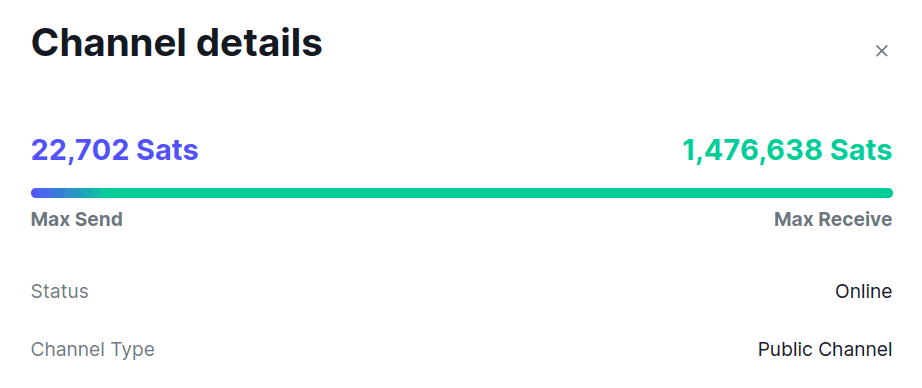
Unbalanced Lightning Channel
Signs your node needs a rebalance
The most common sign is that you’re online, you have channels, and yet forwards fail or simply don’t arrive. Another is when a few channels do all the work until they drain, after which earnings drop and your node becomes quiet. You may also notice that your successful forwards cluster around a small subset of peers, while other channels rarely participate. None of this means your node is “bad”; it usually just means your liquidity drifted away from where demand is.
Set a target before you move sats
Rebalancing works best when you know what “better” looks like for you. A routing-focused node might aim to keep key channels near the middle so it can forward in both directions, while a node supporting a specific community might intentionally skew certain channels to provide inbound capacity to peers. Your target doesn’t need to be perfect or universal; it just needs to be explicit enough that you can tell whether a rebalance helped. Equally important is setting your cost ceiling, because the easiest way to lose money routing is to pay more to reposition liquidity than your node can reasonably earn back.
Strategy A: Circular rebalances
A circular rebalance is the classic approach: you send a payment from your node and have it come back to you through a different path, which shifts balances across the channels involved. Done well, it’s like moving weight from one pocket to another without changing your total holdings. The practical trick is choosing the right starting channel to “spend” from and the right ending channel to “refill,” and then being disciplined about fees. Start with smaller amounts to discover which routes are actually available at an acceptable cost, then increase size once you find a reliable loop. If loops consistently fail, it usually means the network can’t currently support the route at the amount you’re trying, or the fees required exceed your limits.
Strategy B: Let the market rebalance you with fees
Sometimes the best rebalance is the one you don’t pay for directly. Fees influence what kinds of flow your node attracts. If a channel is constantly draining on your side, it may be because you are competitively priced in the direction that empties you, and uncompetitive in the direction that refills you. Small fee adjustments can nudge traffic so that the network’s natural demand slowly pushes you back toward your target balance. The key is restraint. Dramatic fee swings often reduce overall flow, and tuning fees without watching outcomes can lead to “dead” channels that neither drain nor refill.
Strategy C: Peer and channel management is a rebalance tool too
Not every imbalance problem is solvable by looping. Some channels are simply misaligned with how the network wants to route through you, or they connect you to parts of the graph that don’t create useful paths. In those cases, the most effective “rebalance” is structural: add a complementary peer that creates natural triangles through your node, resize channels to match the flow you actually see, or retire channels that never become productive. This is also where thinking in roles helps. A few well-chosen channels that match real demand often outperform a long tail of channels you constantly need to rescue.
Strategy D: External liquidity moves when loops aren’t enough
When circular rebalances are too expensive, too unreliable, or too limited by route availability, you’re left with the blunt instruments: moving value between layers or between on-chain and Lightning to change your inbound/outbound profile. This is costlier because you may pay chain fees and accept more operational complexity, but it’s sometimes the most rational way to reset liquidity at meaningful scale. The practical approach is to do it in smaller steps and treat it like infrastructure maintenance rather than something you improvise during an outage.
Choosing what to rebalance first
If you rebalance everything, you’ll burn time and fees without learning much. The best starting point is usually the channels that both matter and hurt: the ones tied to your most frequent forwards, the ones whose imbalance repeatedly blocks payments, or the ones that connect you to valuable parts of the graph. Rebalancing low-activity channels can be fine as a learning exercise, but it rarely moves the needle. Your early goal should be simple: make the channels that already want to be useful actually usable more of the time.
A lightweight routine that works
A sustainable routine beats heroic one-off sessions. Check which channels drifted outside your target range, pick one or two that are currently constraining flow, attempt a modest circular rebalance within your fee limits, and record the result. If it fails, reduce the amount or try a different path rather than forcing it with high fees. Over time you’ll build intuition for which peer combinations refill you cheaply, which channels are natural drains, and what fee limits are realistic in different network conditions.
Common mistakes to avoid
The biggest mistake is rebalancing without a goal and then assuming any movement is progress. The second is paying high fees just to make a chart look balanced, especially if your node doesn’t have the volume to earn that back. Another common trap is fighting the grain of your peer set: if your channels naturally create one-way flow, forcing them into symmetry can reduce your usefulness. Finally, remember that reliability matters as much as balance. A perfectly balanced node that’s often offline, slow to respond, or poorly connected will still underperform.
A note for LN+ Liquidity Swaps users
If you join liquidity swaps on LN+, there’s a practical bonus after the swap completes. Once all the channels are open, LN+ provides an option and clear instructions for swap participants to rebalance the shape they just formed, whether it’s a triangle of three nodes, a square of four, or a pentagon of five. That’s a nice, tool-agnostic way to turn “we opened coordinated channels” into “we also improved the liquidity distribution across those channels,” which can help the group route better sooner instead of waiting for balances to drift into place naturally.
Takeaway
Rebalancing is less about chasing perfect symmetry and more about keeping your node routable at a reasonable cost. Pick targets that match your goals, start with small, fee-disciplined circular rebalances, use fees to invite the right flow, and don’t be afraid to fix structural issues by changing peers or channel sizes. If you treat rebalancing as routine maintenance rather than a crisis response, your routing tends to become steadier, your fee spend becomes predictable, and your node becomes easier to run.
I like this as a base structure and explanation of balancing/rebalancing channels. What are the next steps? The to-do list must be long and detailed. :-)
If there were an option to direct send our LN pool liquidity credits to other users here it would allow for more direct user to user negotiations for value exchange. For example, one user opened a channel on an expired contract, I would have paid them back in credits if that were an option.
this is a great post thank you .. One thing I've learned managing my channels manually — tracking which pairs actually earn fees vs which ones just drain liquidity is key to knowing where to rebalance. I built a small dashboard for my own node that shows top routing pairs by fee earned and flags which channels need fee adjustments, rebalancing etc.. started as a small tool for myself and now it's a full blown Bitcoin control center Happy to share if anyone's interested MIT license github.com/lioranecho-cpu/lightning-control-center and i'd love some feedback
Thanks for this post. It is a good start, but it is very basic and doesn't provide clear instructions. Any plans to extend it with a manual, or at least links to resources that can help users dealing with the different balancing tools and methods?
Hi yes actually i'm working on that , a proper manual is on the roadmap , For now the GitHub README has installation steps. What specific topics would be most useful for you? Rebalancing strategies? Fee optimization? Channel management? Your input would help me prioritize. the easiest way right now is to give an Ai the github link , this is a prompt i wrote that works really well with Claude ,Grok and Chatgpt
"Read this GitHub repository and walk me through its features, installation, and how to use it as a Lightning node operator: https://github.com/lioranecho-cpu/lightning-control-center
Explain each page and feature like I'm new to running a Lightning node. Include tips on channel management, fee optimization, and rebalancing strategies." better than reading a manual , i'm planning on actually maybe adding an AI assistant in future releases if it doesn't bloat the code and make it slow , I've build a bot assistant on my satslist.shop site to help with the process of listing and navigating i might do something similar for lcc major issue is it gobbles tokens and becomes very costly to maintain .. but definitely try the prompt it works .....
tradenetLND check out my LCC @ https://github.com/lioranecho-cpu/lightning-control-center the read me file ,even if you are not using LCC if you run the prompt for grok or Claude.. (chatgpt is annoying too chatty ), they will both give you some pretty good tips on rebalancing which you can apply independently of which software you run
I don't wanna give you an exact date but I'm planning to start this coming week , so i would say pretty soon within 2 weeks for sure .. i'll keep you updated
@tradnetLND wanna be a beta tester ? the umbrel install is done :) scroll to the bottom for the Claude prompt it will guide you through installation https://github.com/lioranecho-cpu/lightning-control-center/blob/main/UMBREL.md
let me know if you do install it and want to beta test it so i can send you the PRO access code lioranecho@gmail.com
not wild at all it's a great idea, but LCC is more geared toward node runners , node runners want better channel tools, not so much payment UX features ... i'll definitely put it on the list though , start9 comes first and RaspiBlitz
Hey ... the app is all finished just waiting on the start9 team .. because of the update i had to rewrite some code and make some changes but it's all done ..










Stinger32LND wrote 11 months ago